Saturday, 16 June 2012

Moaning - Apology of a healthy and positive behavior


5389383515_f98f9bb582.jpgFrench people are the gold medalist of moaning and cherish this cultural treasure. Here is an exclusive anthropological journey in the mind of a French girl.
Moaning – A constructive attitude towards life
Moaning is in. Moaning is a proof of intelligence, the evidence that we, French people, don’t take things for granted: we challenge them, constantly.  It also shows a commendable and romantic aspiration for a better world. We are not satisfied with our current conditions and we seek a constant improvement! We are extremely cynical, yes: but it is only the mark of a laudable perfectionism. I agree, it is not easy to live or work with a French person if you are not a moaner yourself. It can be tiring and even depressing sometimes (big pat on the back of my husband). But it has its advantages: the moaner is usually not a naïve person. The moaner is not afraid of being rude and putting his/her foot down. The moaner faces problems instead of cowardly avoiding them. The moaner is a formidable booster for perfection.
Moaning – An alternative to depression
For French people, moaning is also a need, a pressure valve to prevent the anger from accumulating and causing severe psychological damages. It is the expression of a frustration. And everyone knows how important it is to communicate one’s frustrations as it is the first step to solve them. Thus, moaning is a healthy and relaxing hobby, which even reduces the chances of heart attacks.
Moaning – A booster of social life
What greater thrill than to bitch about something (or someone) in a group? Collective moaning is even healthier than its individual version. It creates a sort of emulation. Above all, it strengthens the bonds of the moaners. A collective moaning sessions is a formidable generator of common souvenirs, common secrets: the best way to create a sense of belonging to a group! My favorite moaning partners have become my best friends in life (or is it the opposite?) and I long to the moaning competitions with them. Similarly, moaning can be seen as an attempt to strengthen one’s marriage (hint!).
Moaning – The celebration of a rich cultural legacy
French people are amongst the biggest moaners in the world. Not only we moan, but we are proud of moaning.  And I am not the only one saying it: http://www.dailymail.co.uk/news/article-1274368/French-boast-comes-moaning-does-better-do.html . And France can boast about having the greatest moaning specimen, proud children of the French revolution, from Napoleon to de Funès. French people being the inventors of the “chauvinism” concept, they have no other choice but to perpetuate the moaning tradition.
Moaning – Risks of deficiency
As a professional moaner, I cannot help but being irritated (once again) when people told me I should not moan. It is the negation of my identity and the denial of the most elementary freedom! So let’s talk about the other extreme: the Care Bears followers (Bisounours en francais). Everything is good, the world is beautiful, the birds are singing, the sun is shining, and other expressions of foolishness. A category of Anglo-Saxon people, especially women, are prone to this behavior (apology for the easy cliché, but the typical Hollywood movies are not going to prove me wrong). My latest experience was with a group of non-Indian women (mainly Anglo-Saxon ladies) married to Indians. One of them, an American, started criticizing (Bad girl! This is not worthy of Care Bears) foreigners who were complaining about India. According to her, if you are living in India, you should stop complaining about the numerous inconveniences. “Embrace them, or leave the country.” I will let Beaumarchais’ Figaro answer that one: "Without the freedom to criticize, there is no true praise". So there! No hard feelings…

Monday, 19 March 2012

Truth vs. lie


2875298501_cbda64f779.jpg"A little inaccuracy saves a world of explanation". C. E. Ayers
Assignment: Is it always essential to tell the truth or are there circumstances in which it is better to lie?

Lying is bad. It is a sin and I know it. Since I am a kid, my parents have been warning me, my relatives have been advising me, the priests have been threatening me: do not lie! I have always believed that any lie will further reduce my chances of getting the cosy place to heaven I desire. But during my marriage preparation course, I was told that relationship is more important than being right. I had soon adapted this powerful saying to the convenient “Relationship is more important than telling the truth”.

I confess I have a quirk: only French hairstylists can touch my hair. Untrusting any non-French experts with my head invariably results in a hair disaster. In these conditions, I have no other choices than to pay a prohibitive amount to get my hair cut at a high class French salon in Mumbai. And every time my dear husband notices the superb - that goes without saying- outcome, he asks for the fee of the service. With his haircut’s value barely crossing two figures, I am bound to make small adjustments. So I divide the cost of the haircut by four. A lie? Hardly! It is just a small mathematical trick, a kind of currency translation to adapt to his price standards. At the same time, I protect our household from endless heated arguments and their usual collateral damages: stress, insomnia, suspicion or even worse: loss of credit card. Indeed, he would definitely dispute the yet undeniable fact that I am actually saving money: of course, a four digit rupee haircut in Mumbai is a bargain compare to a Mumbai to Paris flight ticket combined with a two figure euro haircut in Paris. Hence, this minor imprecision is nothing but a devoted contribution to the harmony of our marriage.

In France, one does not talk about money: it is impolite to enquire someone’s salary; it is taboo to ask for the price of anything outside a shop. So when my Indian sister-in-law asked me how much our rent was with her usual and insatiable curiosity, I flushed with embarrassment. I felt as she was invading my personal space. I could not bring myself to tell her the amount, nor could I abruptly refuse to answer. So I wriggled out of the situation with an elegant and chaste “I don’t know”. “Anne, that is what I like about you: you are so innocent! I would have nagged my husband forever to know the amount.” Her naivety was touching. Was it my fault if she misunderstood my thoughtful attempt to preserve both our cultural sensitivities? Should I have disabused her and run the triple risk of, first having to justify my white lie; second offending her by conceding my reluctance to share everything with her; and third losing my unexpected and welcomed new status of “innocent girl”? I had quickly chosen to quietly encash the free brownie points. This inaccuracy was driven by a case of force majeure: keeping intact the relations with my husband’s family.

Life has showed me that some circumstances require the truth to be reinterpreted, especially if the goals are pure. And William Blake wrote that “A truth that’s told with bad intent beats all the lies you can invent”. For sure the reciprocal logic must also be correct, isn’t it? “A lie that’s told with good intent beats the truth used to torment”. Does that mean I may still go to heaven? Can my conscience now lie – sorry, I mean rest – in peace?

Tuesday, 13 March 2012

The lighthouse at the end of the world


4092282915_ba13afd8f7.jpgWe made it! Somehow I had survived the dreadful landing. My grey-haired, frequent flyer fellow passenger had offered a reassuring hand to support me during my ordeal. Although I was still as red as a ripped tomato and panting like a dog I was so relieved that I almost kissed him on both cheeks! But I had some ounces of dignity left. The rejoicing was for later, I instructed myself exhaling slowly; my initiatory voyage was not over.  

It had been a bold decision to leave my own comfortable and predictable country to spend three months in crazy and sparkling India, not to mention in the most remote village of Tamil Nadu that was probably not even listed by Google Map.

As I exited the aircraft, the powerful heat and humidity strangled me. I felt sticky and moist. Why on earth could I suddenly picture granny’s desuetude gigantic cupboard filled with old embroidered linen? Why could I experience the nostalgia of her blue tiled kitchen? It was not Proust’s madeleine but the smell, wet and dusty, that seemed to definitely convey me into another dimension.  

Walking through immigration, I decided that my artistically stacked up luggage trolley would be my bodyguard, my shield. Because I confess: I was trying to be strong and brave like a bull, but that night I felt like a frightened rabbit, ready to bolt .  I proceeded through the faintly air-conditioned corridors of the airport, in-spite of the heat my heart felt cold. “But it is my dream come true!” the thought drew a feeble smile. A dream? Well, more like a nightmare now.
The exit doors automatically opened in front of me. A sudden wave of oven-like high temperature swallowed me. The sudden outdoor darkness left me disoriented.  Here I was, a valiant gladiator yet vulnerable, in the middle of an overcrowded and cramped arena.

There were dozens; no hundreds; no wait, thousands of pairs of dark eyes belonging to exhausted Indian relatives apathetically waiting for their beloved sons, husbands or grand-children to show up, in the dead of night. I was unable to capture their humanity; like disturbing, expressionless and dull puppets, hypnotized by the airport doors, glued to an incredible torpor.

 I frowned, yes, they had a funny kind of, was that a towel draped around their waists. “Of course must be a lungi! They mentioned it in the Lonely Planet!” I recalled. But where was the colorful and vibrant India I had been promised? Where was the exuberance, the noise, the noise, the powerful energy?  My stomach churned: Dear god would I be able to survive here?

Eventually I saw him beaming at me like the Cheshire Cat.  “Thanappan! I am so happy to see you! Thanks for receiving me”. “Welcome to India, Anne!” he winked at me. As he continued to grin his teeth gleamed in the dark like a beacon from a lighthouse.

And I was certain I would pull through.

Workshop


Dear reader,

I am attending a writing worshop and I have decided to publish some of the pieces I wrote (thanks to Kavita for her editing). Not everything is autobiographic.
I hope you will enjoy.
Cheers

Wednesday, 22 February 2012

It is not fair!


Calimero.JPG
Do you know this cartoon character? Calimero is a poor cute little black chicken who is nice with everyone but who thinks the world is against him. I like Calimero. And like any French person, I like to complain:  “That is not fair, I am ALWAYS the victim, it is not because I am small and weak that!”….
I had decided to take some action. Enough was enough. I decided to call the Hindu pantheon’s customer service center to bring up the matter.
I fiercely grabbed my phone and typed the number that Just Dial had sent me.

- Dear customer, we value your opinion. You call may be monitored from quality insurance purposes. If you are calling for a prayer, press 1. If you wish to send a virtual Prasad to your favorite god, press 2.

I had always hated these Voice Systems. I started biting my nails as I waited for the most suitable option.

- If you wish to speak to one of our gods’ representatives, press the # key.

Got it.

- Thank you for your call. Your time is important to us. Your estimated waiting time is 10 minutes.

I decided to take a deep breath: “Hold on, Anne! You are almost there!! Don’t give up so easily!”
So I waited, patiently eating all the chocolates from the box that was giving me company….

ThanksforcallingHindupantheonscustomerservicecentermynameisrajhowcanIhelpyou?

I jumped, quickly trying to recall what I wanted to say. I needed to sound aggressive and determined.

- Oh yeah. Hi! My name is Anne and I am French. How shall I call you? God, Mister god? Buddy?

I told you: mynameisraj. I am a representative.

- Ok. I’ve called to complain: Why can’t I enter the Padmanabhan temple in Trivandrum? WHYYYY?

- To enter the premises and be a little closer to the treasure, there are rules: you need to wear a sari if you are a lady and a lungi with bare chest if you are a man. You also need to be “non foreigner”.

- What is a non foreigner?

- A person who is Indian.

- How do you define “an Indian”?

- It is a person who looks Indian.

- So do you mean that a foreigner is a person who does not look Indian?

- Exactly

- So citizenship does not really matter here.

- No, you got it.

- If I summarize, you mean I have to wait outside the temple, babysitting the pram while my husband and my son are enjoying themselves inside while performing a tribal dance of my invention to avoid the hungry mosquitoes?

- Hmmm yes. You can also buy some nice banana chips. There are good in Kerala. Kerala is not called God’s own country for no reason.

- By the way, my son is French.

- I told you, citizenship does not matter.

- But that’s not fair!!! Sometimes people think I am Indian, just because I am married to an Indian man! They even frown with misunderstanding and disappointment when I tell them I am still very much French.

- But Beta, you don’t look Indian. You cannot enter the temple. Period.

By that time, I had lost my patience. God or no god, they were going to experience the famous French cribbing superpowers. I breathed hard, mentally keeping a picture of Calimero, my idol.

- But that is not fair!!!

- …

- This rule is stupid! And I am going to prove it. Can my Canadian neighbor enter the temple?

- If he looks Indian, yes.

- Yes, he does. Both his parents were born in India. He knows less Hindi than me though.

- That does not matter, Beta.

- DON'T BETA ME, PLEASE! Do you know what beta means in French? It means “stupid”!

- Sorry Beta. We have to call people “Beta”, Everyone is a Beta of God!

- Tell me something.

- Something

God, they are even trying to be funny!

- Don’t you dare using that joke on me! I practically invented it.

Sorry. We are told different techniques to deliver our message.

- t’s ok. So, do you think a Pakistani look Indian?

- Yes, of course, Beta! You know, right, that Pakistan and India were one united country before 1947.

- Hum, yes. So, you would grant the permission to enter the temple to a Pakistani?

- God, no!! He is not Indian!...... ARGH!!!

The phone suddenly went blank.
Haha! I stood and start an enthusiastic winning dance. Haha, Mynameisraj, don’t you want to tell another joke to your Beta? You lost your God coolness? I tell you: good for you!

But the small feeling of guilt I experienced during the entire call was becoming unbearably overwhelming. Did I go too far with the God’s representative? Did I cross the limit? Who was I, little creature, to question God’s rules?

I started searching for my water bottle in my bag, trying to regain composure. Then I felt a plastic bag: the banana chips I bought in Kerala while waiting outside the temple! I smiled while opening the packet. Oh God! Mynameisraj was right. These golden chips are like heaven: there are the hidden treasures of Trivandrum! Maybe God did not allow me in his temple, but he definitely put a little bit of himself in these chips. 
Later on, I called back the customer service center and left an apology on their prayer voice mail. I hope mynameisraj got it. If not, I am sure that God heard me and will forgive the stubborn French girl cum Calimero I am.

Tuesday, 14 February 2012

The box guys who think outside the box


"Anne, I want to see the wabamata. They were showing a documentary the other day on TV. You know, it is fascinating!"

Last time my mum told me about something fascinating shown on TV, it was about the octopus: "Did you know? The octopuses are very smart creatures", she nodded convincingly. I had stop all activities and burst in laughter.
You have to understand that octopus is said "poulpe" in French. And somehow, the phrase "Le poulpe est un animal tres intelligent" has a huge comical potential.
It had been a torture to listen to my mum without giggling hysterically while she was describing half laughing, half serious, the remarkable feats of the octopuses.

"The wabamata?" I repeated stupidly.
"Yes, you know, these people who deliver the lunch boxes across Mumbai!"
Please, be lenient. The word "dabbawallah" is quite complicated for any non Indian to remember.

After all these years in India, I had kind of forgotten the fascination of westerners for dabbawallahs. But it is true, what they are able to achieve is quite impressive. Picking up and delivering lunch boxes without fail and on time to hundreds of thousand people, even during the heavy rains, is a great accomplishment for these mostly illiterate people.
It is also said that some great American business schools come to India to study this miracle of supply chain and logistic. The industry is more than 125 years old during. Over these years, a simple although very efficient coding has been developed, that guarantees the quality of service.

But like a sport even, watching the dabbawallahs in action is always better on TV. You need the big picture, you need to step back to appreciate the beauty of the movement.
I had remembered the documentary that my mum was referring to. It was really nice to follow them throughout their journey. I had flash back memories of two parts of the documentary.

Though the entire movie was from the dabbawallah's perspective, this scene was taking place in an Indian kitchen in the morning. The wife of one dabba's recipient was cursing the dabbawallah who was impatiently waiting outside for her to finish cooking the priceless "Ghar ka khanna". She could not bear hurrying up: "He can wait four or five minutes". These five minutes were precious for our guy and any additional delay may jeopardize their punctuality.

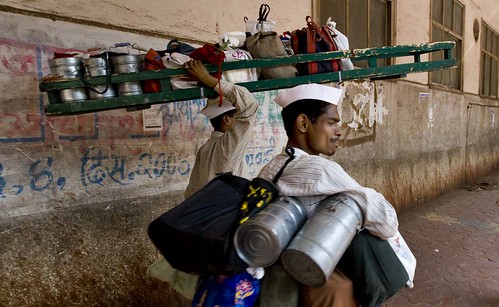
The second scene was taking place in a local train station. Two dabbawallahs were carrying a huge platter of dabbas on their heads and were trying to enter an overcrowded train to reach their destination on time. Some people do have a tough job.

When you meet a dabbawallah on his cycle proudly wearing a Gandhi cap, carrying five lunch boxes, it is very easy to forget the well oiled and remarkable organization behind the man. So today, let me be western and impressed: Well done, box guys!
 2645958084_d8ee3d2150.jpg

Wednesday, 8 February 2012

India, homeland of the greatest yogis


Obvious, isn't it? It is hardly a cliché: yoga is part of Indian culture.
From the foreigner tourists eager to stretch their pale bodies on Kerala beaches, to the urban middle aged professional trying to lower their stress level, to the greatest yoga gurus able to fast for hundreds of days and bend their bodies in the most unlikely poses, every yogi, whether they are experts or not, aim at reaching the famous nirvana.
And everyone is looking for an example to follow, a guide, a guru.

Dear reader, I will spare you the challenges of looking for the perfect yogi. I found it. You may not believe it, you may irritably roll your eyes, you may even laugh at me, but the truth is the truth. And haven't you learned that you should always look behind initial appearances? See? There you go.

After loads of research and endless hours of observation, I can guarantee you that you will not find a better yogi than the Indian stray dog. Yes, yes, you read it correctly.
OK, I admit: in the mammal category, the cow is also a great challenger, nonchalantly wandering on the busy streets of Indian cities. But to be fair, it is largely inherent to its quality of sacred animal: she is the queen of the road and every other moving vehicle or animal has to give way to her majesty. Sorry, but for me, it is cheating.

You still doubt my theory? No problem, I am more than happy to prove it to you.
Let us define what makes a great yogi.

First: Ability to master the intricate yoga poses. Well, easy: why do you think one of them was named after our hero? Yes, yes, you know what I am talking about: the famous downward facing dog!!!

Second: Developing a deep passion for chanting mantras in group. I discovered that one during the many times my son woke up in the early hours of the day. Have you never heard a pack of hounds barking and howling at 4am? It is not kneejerk animal behavior; it is a complex series of very powerful mantras, able to seduce all their other doggy friends.

Third: Be truly happy, despite all circumstances. It is true; it is not easy to be a stray dog. You don't have a home; you have to hunt for food everyday. But these yogi masters teach us a great lesson of life: they are always happy, rhythmically wagging their tails. Their faith in humanity is indestructible. They will always come to you, you stranger, with the affectionate hope that you will be a great companion.

Last and not least: Achieve nirvana. Have you observed a dog casually ying down on Bombay roads? It is perfectly still, nothing can disrupt its inner peace: not the busiest traffic of the world, nor the fierce honking of the angry taxi driver unsuccessfully trying to flush it out of the way, nor the scariest trucks. If you observe closer, the dog does not flicker. It looks dead and inarticulate for its body performs yet another supreme yoga pose.
That, my friend, is the last stage of nirvana that only a few creatures in this world are able to achieve.

The next time you see a stray dog, don't despite it. But watch. Watch and learn, my friend.